Every week, thousands of websites go offline — not because they broke any law, but because someone filed a DMCA complaint and the host panicked. That is the problem DMCA ignored hosting was built to solve.
In this guide, you will learn exactly what DMCA ignored hosting is, how it works, who actually needs it, and how to pick a provider you can trust. No fluff, no scare tactics — just straight answers.
What Does "DMCA Ignored" Actually Mean?
The Digital Millennium Copyright Act (DMCA) is a United States law that lets copyright owners ask hosting companies to remove content they claim infringes their copyright. The process is simple: send a takedown notice, and most US-based hosts delete the file or suspend the account immediately — often without telling the website owner, and often before verifying whether the complaint is even valid.
A DMCA ignored host operates outside US jurisdiction — typically in countries like the Netherlands, Romania, or Iceland — and is not legally bound by the DMCA. More importantly, they use a review-first policy: instead of acting on every complaint automatically, they investigate each one to determine whether it has merit before taking any action.
This does not mean they allow illegal content. It means they refuse to be weaponised by bad-faith actors who use fake or abusive DMCA notices to silence competition, harass bloggers, or censor commentary.
Why Do Fake DMCA Complaints Happen?
You might wonder: who would file a fake copyright complaint? More people than you would think.
- Competitors filing claims against review sites or comparison pages
- Governments or corporations trying to suppress criticism or investigative journalism
- Scammers demanding payment to "withdraw" their complaint
- Automated bots that scan the internet and fire mass takedown notices based on keyword matches, not actual review of content
- Disgruntled individuals targeting personal websites or small businesses out of spite
When a complaint like this lands at a regular US host, the host's legal team simply forwards the notice and asks the customer to remove the content — or pulls the site entirely. Proving you are innocent comes after your site is already down.
With a DMCA ignored provider, you get the chance to respond first.
Who Needs DMCA Ignored Hosting?
The list is longer than most people expect:
Content Creators and Media Sites
If you run a review site, a news blog, a forum, or a community platform, you are a natural target for abusive DMCA claims. User-generated content in particular makes traditional hosts nervous — even when every post is perfectly legal.
Digital Privacy Advocates
Journalists, whistleblowers, and activists who publish information that powerful organisations would rather keep hidden frequently find their sites hit with takedowns. DMCA ignored hosting gives their work a stable, resilient home.
File-Sharing and Archive Sites
Libraries, historical archives, and platforms hosting public-domain or Creative Commons material still receive DMCA notices — often in error. Offshore hosting means you can stay online while you dispute the claim.
Businesses Targeted by Competitors
If you run a comparison or review site in a competitive niche, expect attempts to use copyright claims to pull your pages down. A provider that reviews complaints protects your business continuity.
Adult Content Platforms (Within Legal Limits)
Legal adult content — produced with verified, consenting adults — is constantly targeted by frivolous complaints. Offshore jurisdictions that have clear legal frameworks for this content provide much better protection.
What DMCA Ignored Hosting Does NOT Cover
This is important, and any honest provider will say it plainly: DMCA ignored hosting is not a free pass to host illegal content.
Legitimate DMCA ignored hosts still prohibit and act on:
- Child sexual abuse material (CSAM) — always removed immediately, always reported to authorities
- Phishing sites and financial fraud
- Malware distribution
- Spam and unsolicited bulk email
- Genuine copyright infringement (where the complaint is valid and verified)
- Content that violates the laws of the hosting country itself
At Qazi.Host, our policy is simple: we review every complaint. If it is genuine, we act. If it is abusive or unsupported by evidence, we reject it and keep your site online. We do not allow anything illegal, and we never will.
How the Review Process Works
When a DMCA ignored host receives a takedown notice, a typical fair process looks like this:
- Receipt and logging — The complaint is recorded with a timestamp and all details noted.
- Initial review — The abuse team checks whether the complaint identifies specific content, names a rights holder, and provides verifiable evidence of ownership.
- Customer notification — The account holder is notified and given a chance to respond or provide counter-evidence.
- Decision — If the claim is valid, content is removed and the customer is informed. If it is invalid, the complaint is rejected and documented.
- Appeal — Both sides may appeal the decision through a defined process.
Compare this to a US-based host, where step 1 is often also the last step: receive complaint, delete content, done.
Where Are DMCA Ignored Servers Located?
The two most common jurisdictions are:
Netherlands (NL): Dutch law requires actual court orders for most content removals. The country has strong privacy protections and well-established infrastructure. Most DMCA notices have no legal force here.
Romania (RO): Romanian courts have historically taken a nuanced view of copyright complaints, and the country is outside the direct reach of US legal pressure. Excellent connectivity and uptime track records make it a solid choice.
At Qazi.Host, we operate infrastructure in both countries, giving customers redundancy and flexibility.
Is DMCA Ignored Hosting Legal?
Yes — for the hosting provider and for you as the customer, as long as your content is legal in the hosting jurisdiction.
The DMCA is a US law. It applies to US companies and, in limited ways, to their international partners. It does not apply to a Dutch or Romanian hosting company that has no US presence. Those companies are governed by EU and local law instead.
Hosting legal content on a non-US server is entirely lawful. What would make it illegal is hosting content that is illegal in the host's country — which a reputable provider will refuse regardless.
Choosing a DMCA Ignored Host: What to Look For
Not all providers are the same. Here is what separates the good ones from the unreliable ones:
- Clear abuse policy — Do they publish what they allow and what they don't? Vagueness is a warning sign.
- Review process, not just a "we ignore everything" promise — A host that claims to ignore all complaints without any review is a liability, not a feature.
- Verified server location — Ask for the actual data centre, not just "offshore." Ask for the IP's WHOIS record if you need certainty.
- Uptime track record — Offshore hosting is only valuable if the server stays online. Check independent monitoring data.
- Responsive support — When a complaint lands and your site is at risk, you need a team that answers quickly.
- Transparent pricing — No legitimate host needs to hide its prices or push shady payment methods.
How Qazi.Host Handles DMCA Complaints
At Qazi.Host, every abuse report goes through a structured review. Our team in the Netherlands and Romania checks each complaint for validity before any action is taken. We do not auto-delete on request, and we do not suspend accounts without reason.
We host legal content from customers worldwide. We protect them from fake and abusive notices. And we are completely transparent about what we will and will not allow — you can read our full abuse policy any time.
If you are tired of waking up to a suspended site because someone filed a complaint without evidence, explore our DMCA ignored shared hosting plans or get in touch to talk through your situation.
Summary
DMCA ignored hosting is legitimate, legal, and increasingly necessary for website owners who need stable, censorship-resistant hosting outside the reach of US law. It is not a loophole for illegal content — it is a fair system where complaints are reviewed instead of auto-enforced.
The key things to remember:
- DMCA ignored means reviewed, not ignored entirely
- Servers are in the EU, outside DMCA jurisdiction
- Legal content is protected; illegal content is still removed
- Choose a provider with a clear, published abuse policy
Have questions about whether your site's content qualifies? Contact our team — we are happy to give you a straight answer before you sign up.
Written by
Ahtsham Khan Qazi
Founder & CEO, Qazi.Host · RHCSA · CCNA · 14+ years in server administration
Runs the shared, reseller and dedicated infrastructure behind Qazi.Host and writes these guides from the servers he administers. Corrections and questions are welcome on WhatsApp.
Read full bio →Related Articles
More guides on DMCA Ignored Hosting to help you make the right decision.
Is DMCA Ignored Hosting Legal? The Honest Answer
A straightforward guide to the legality of DMCA ignored hosting — who it is legal for, where it operates, and what the actual risks are. No legal jargon, no scare tactics.
DMCA Ignored Hosting for WordPress: Why It Matters and How to Choose
WordPress powers 43% of the web — and WordPress sites are the most common targets of abusive DMCA takedowns. Here is why DMCA ignored hosting makes sense for serious WordPress site owners.

Best DMCA Ignored Hosting 2026: 6 Providers Honestly Compared
We tested and compared six of the top DMCA ignored hosting providers for 2026 — pricing, server location, abuse policy, support, and real uptime. One came out ahead on almost every metric.
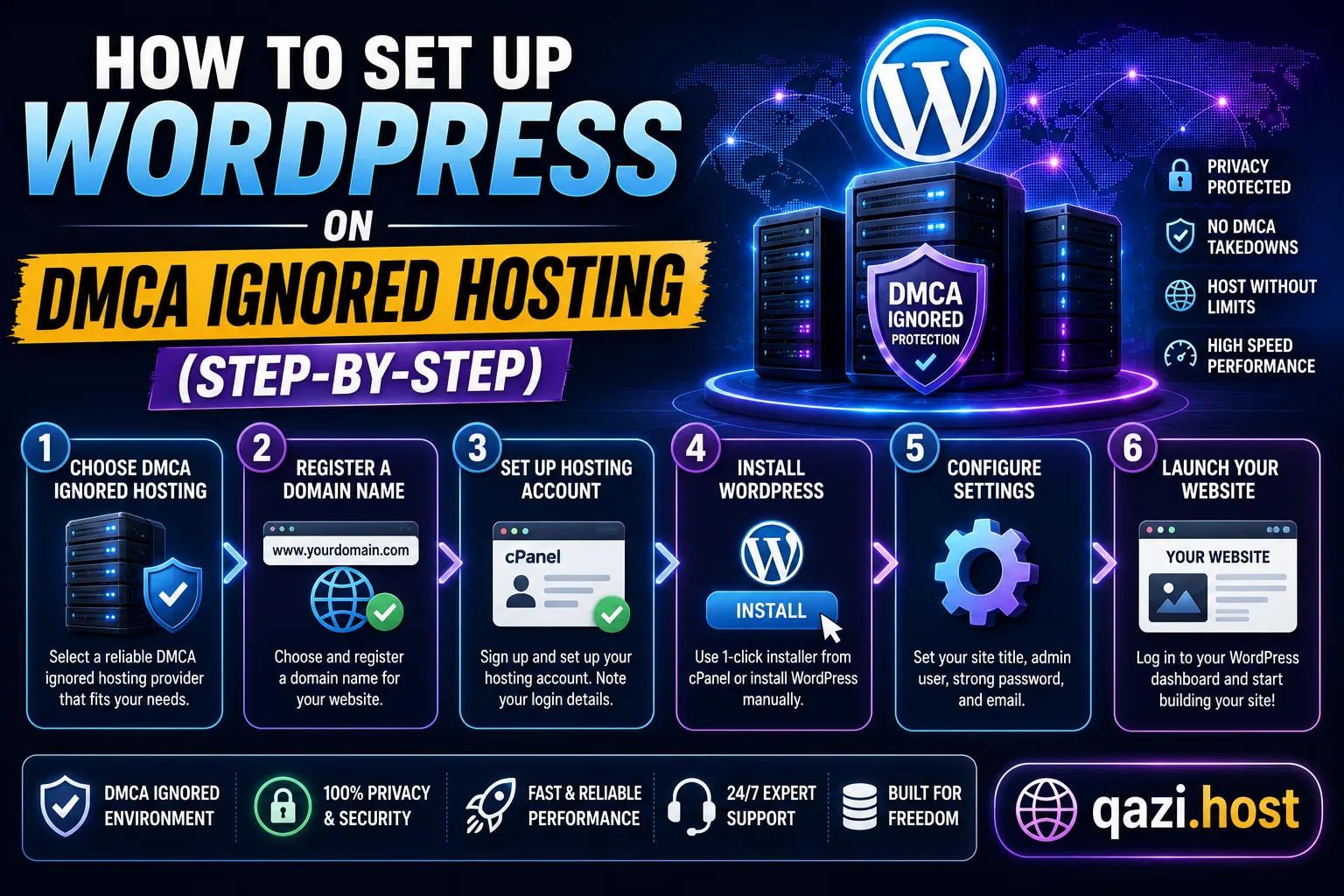
How to Set Up WordPress on DMCA Ignored Hosting (Step-by-Step)
Moving your WordPress site to DMCA ignored hosting is straightforward if you know the steps. This guide walks you through everything from choosing a plan to going live on your new offshore server.