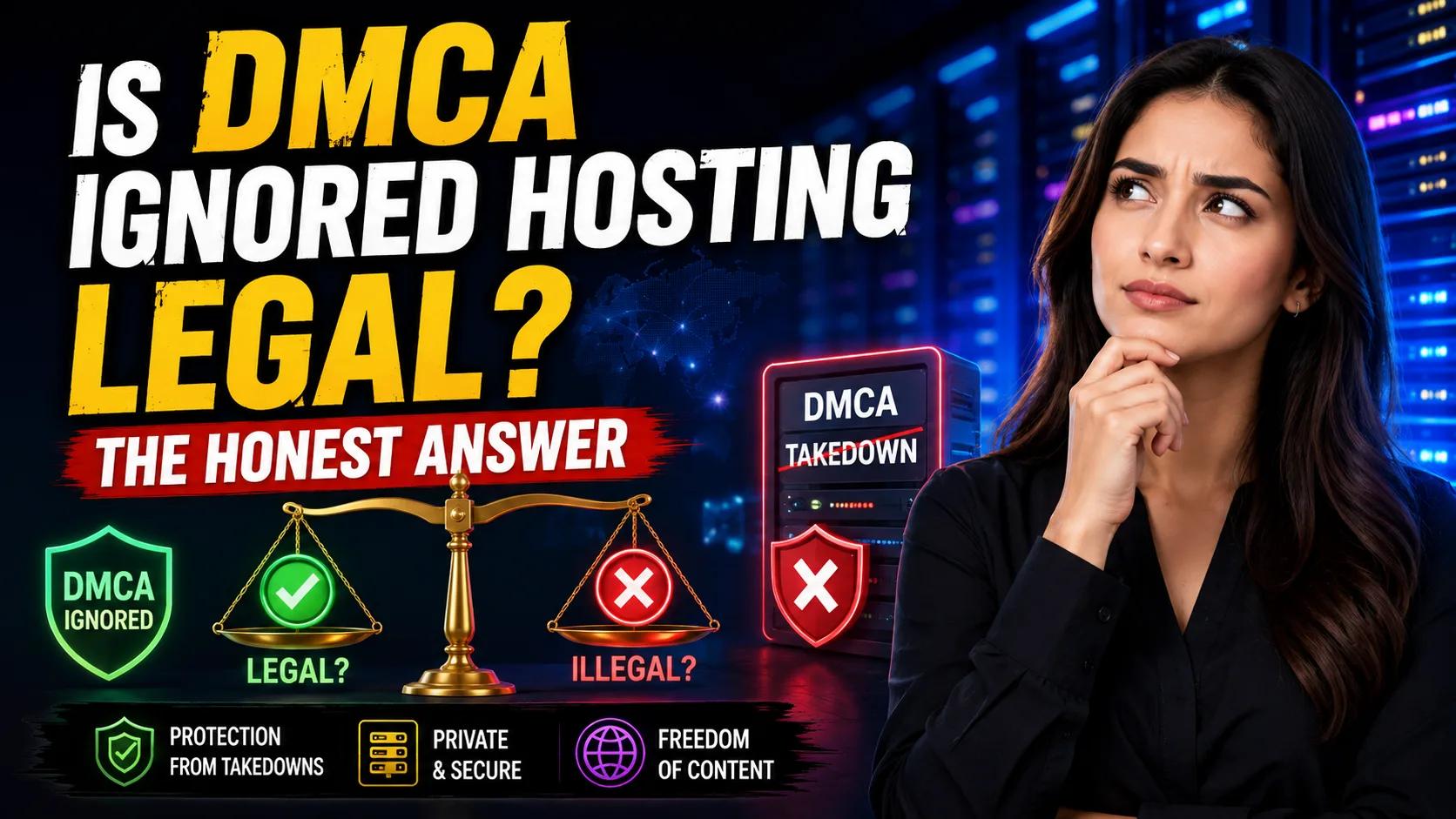
Before you sign up for DMCA ignored hosting, you want to know one thing: is it actually legal? You have probably seen conflicting answers across the web. Some sites treat it like a legal grey area. Others imply it is shady by nature. The truth is far more straightforward than either camp suggests.
Let's go through this clearly, without the fear-mongering.
What the DMCA Is — and What It Is Not
The Digital Millennium Copyright Act (DMCA) is a United States federal law, passed in 1998, that allows copyright holders to request the removal of infringing content from online services. It created a "safe harbour" framework: hosting companies that follow the takedown process promptly are shielded from liability for user-uploaded infringement.
That is it. It is a US law that:
- Applies to US-based companies
- Applies to companies that significantly serve the US market and have US operations
- Does not apply to hosting companies operating solely under EU or other non-US law
A hosting company based in the Netherlands, Romania, or Iceland — with no US legal presence — has no DMCA obligations whatsoever. They answer to local law, which in the EU is primarily the Digital Services Act (DSA), national copyright statutes, and the laws of their specific country.
Is It Legal for the Hosting Company?
Yes. A Dutch or Romanian hosting provider operating under EU law is completely within its rights to decide how it handles copyright complaints. EU law does require hosting providers to act on valid copyright complaints — but it does not require them to act on unverified, automated, or abusive takedown notices.
Reviewing a complaint before acting on it is not only legal — it is arguably more legally sound than auto-complying with every request, because auto-compliance creates a paper trail that could imply editorial control over hosted content.
Is It Legal for You as the Customer?
Yes — as long as your content is legal. This is the key point that never changes regardless of jurisdiction:
DMCA ignored hosting does not make illegal content legal. It protects legal content from being taken down by invalid complaints.
If you host content that is legal in both your country and the hosting country, you have no legal exposure from using a DMCA ignored provider. Full stop.
What About Content That Is Legal in One Country but Not Another?
This is where nuance matters. A few examples:
Political speech and journalism
In some countries, criticising the government online can get a website pulled. Hosting that content on a Dutch server, where press freedom is protected by law, is entirely legal for both the host and the publisher. Many journalists and investigative reporters operate this way deliberately.
Adult content
Legal adult content (produced with consenting adults, compliant with local regulations) is frequently targeted by DMCA complaints from competitors or anti-pornography groups. Hosting it in a jurisdiction where it is clearly legal offers stable, compliant operations.
Cryptocurrency and fintech
Some financial services that are legal under EU regulation face takedown attempts from competitors in markets where they are restricted. Offshore hosting in a permissive jurisdiction keeps the service accessible while remaining within its operating country's law.
When DMCA Ignored Hosting Does NOT Help You
If your content is genuinely infringing copyright — using someone else's original work without licence — hosting it offshore does not protect you. The rights holder can still:
- Sue you personally in your country of residence
- Apply for a court order in the host's jurisdiction (this takes time and money, but it is possible for serious cases)
- Report your domain to the registrar, which is separate from hosting
- Get your payment processors to terminate your merchant account
A legitimate DMCA ignored host — including Qazi.Host — will still act on complaints that are clearly valid and accompanied by evidence of genuine ownership. We review every complaint. We do not protect actual copyright infringement.
The "Bulletproof" Myth and Why It Matters
You may have seen providers marketed as "bulletproof" hosting. These often promise to ignore all complaints including criminal investigations, court orders, and CSAM reports. That is not what DMCA ignored hosting is, and it is not what we offer.
A legitimate DMCA ignored provider:
- Operates in a reputable jurisdiction with rule of law
- Cooperates with valid court orders and criminal investigations
- Immediately removes and reports child sexual abuse material
- Refuses to host malware, phishing, or fraud operations
- Ignores only unverified or abusive takedown notices
This distinction matters legally. True bulletproof providers operating out of lawless jurisdictions expose their customers to serious legal risk — because those providers often disappear suddenly, get seized, or attract law enforcement attention that extends to their customers.
How to Verify a Provider Is Operating Legitimately
Before you sign up with any DMCA ignored host, check:
- Where are the servers physically located? Ask for the data centre name and verify the IP WHOIS record shows a legitimate EU provider.
- Is there a published Acceptable Use Policy? A provider with nothing to hide publishes exactly what it allows and what it prohibits.
- How long have they been operating? Longevity matters in this niche. Providers that have been running for several years without interruption have a track record you can verify.
- Are there real customer reviews? Look for reviews on WHT (WebHostingTalk), LowEndTalk, and Trustpilot — not just testimonials on the provider's own site.
The Bottom Line
DMCA ignored hosting is legal for hosting providers outside the US and legal for customers hosting legal content. It is a straightforward consequence of jurisdictional law: a Dutch hosting company is not bound by American copyright statutes.
What it is not is a blanket permission to host anything. The laws of the hosting country still apply, and a responsible provider enforces them.
At Qazi.Host, we run servers in the Netherlands and Romania. We review every complaint we receive. We do not auto-comply with unverified requests, and we do not host illegal content. If your website serves legal content and you are tired of bad-faith takedowns, we are the kind of host you are looking for.
Explore our reseller hosting plans — ideal if you manage multiple sites — or shared hosting for single-site projects. Questions? Get in touch any time.
Written by
Ahtsham Khan Qazi
Founder & CEO, Qazi.Host · RHCSA · CCNA · 14+ years in server administration
Runs the shared, reseller and dedicated infrastructure behind Qazi.Host and writes these guides from the servers he administers. Corrections and questions are welcome on WhatsApp.
Read full bio →Related Articles
More guides on DMCA Ignored Hosting to help you make the right decision.
What is DMCA Ignored Hosting? Complete Guide
DMCA ignored hosting lets website owners publish content without the fear of instant takedown from questionable abuse complaints. Learn how it works, who needs it, and how to choose a legitimate provider.
DMCA Ignored Hosting for WordPress: Why It Matters and How to Choose
WordPress powers 43% of the web — and WordPress sites are the most common targets of abusive DMCA takedowns. Here is why DMCA ignored hosting makes sense for serious WordPress site owners.

Best DMCA Ignored Hosting 2026: 6 Providers Honestly Compared
We tested and compared six of the top DMCA ignored hosting providers for 2026 — pricing, server location, abuse policy, support, and real uptime. One came out ahead on almost every metric.
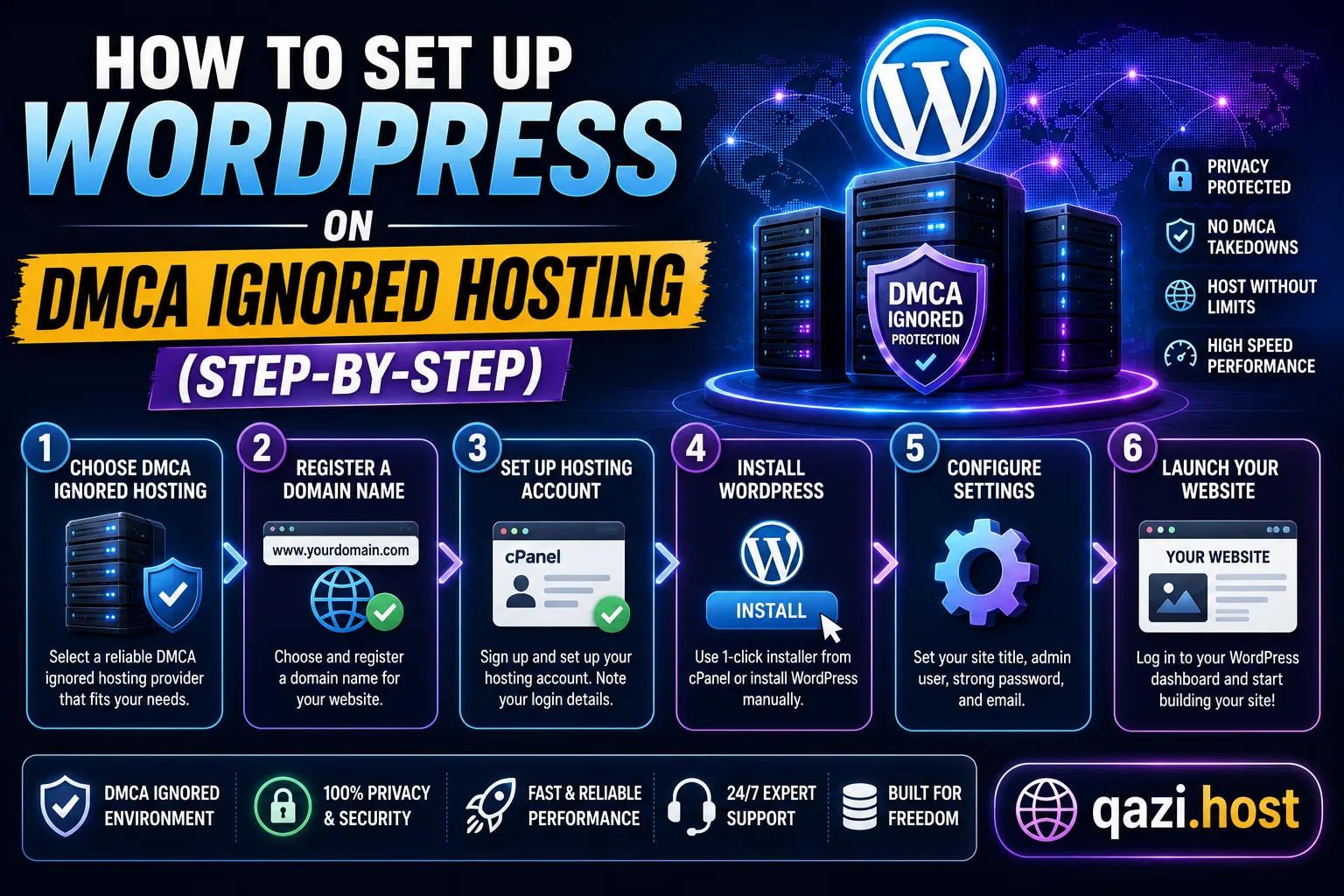
How to Set Up WordPress on DMCA Ignored Hosting (Step-by-Step)
Moving your WordPress site to DMCA ignored hosting is straightforward if you know the steps. This guide walks you through everything from choosing a plan to going live on your new offshore server.