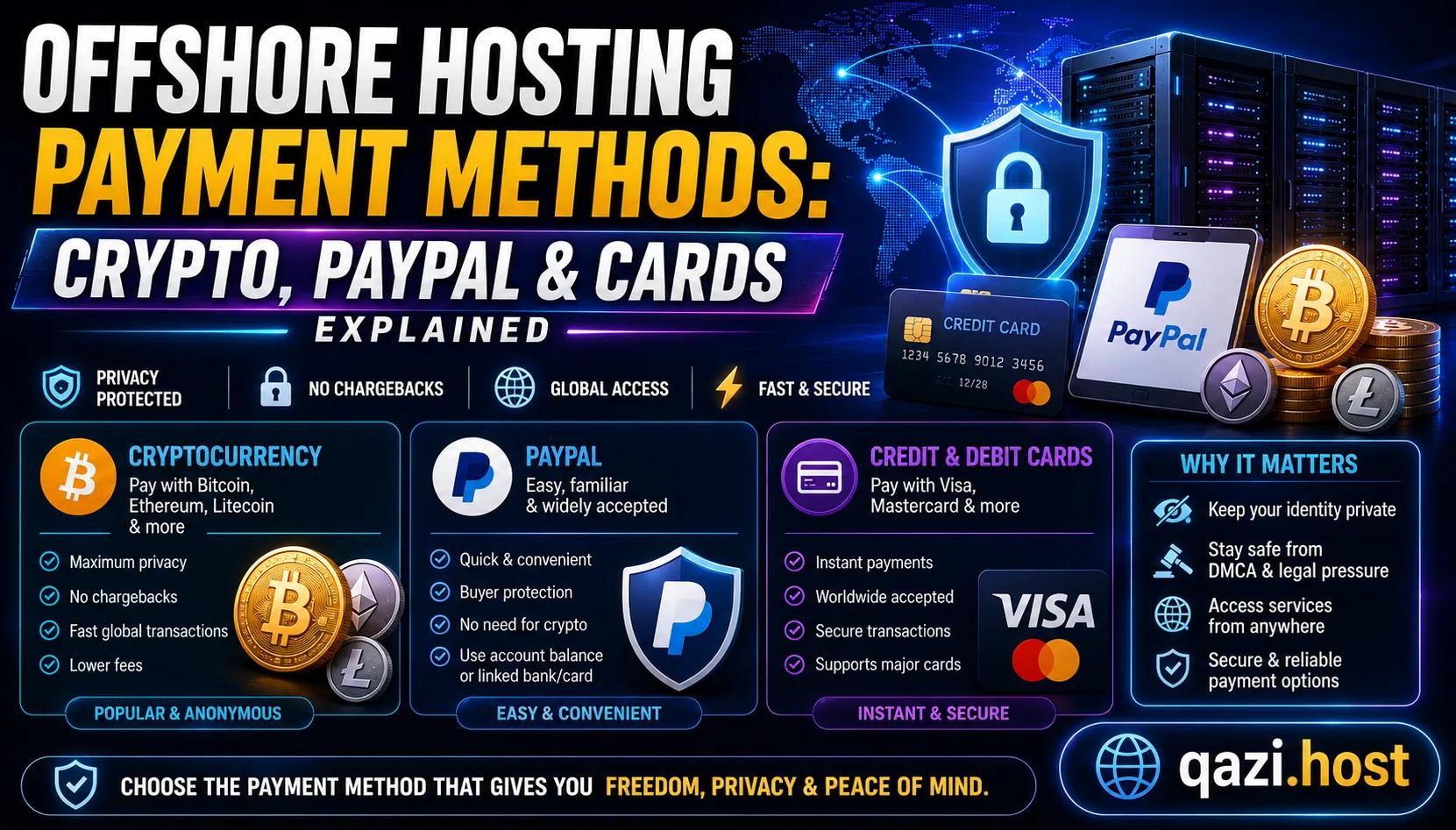
Offshore hosting attracts customers who care about privacy, resilience, and autonomy. It makes sense, then, that payment method is often a significant consideration — not just for convenience, but for the degree of financial privacy it provides.
This guide walks through the main payment options available for offshore hosting purchases and explains the practical trade-offs of each.
Credit and Debit Cards
How It Works
Standard card payments go through a payment processor (Stripe, PayPal's card processing, or a similar service). The hosting company receives the payment; your bank sees the merchant name and amount on your statement.
Privacy Level: Low
Card payments create a clear record: your name, card number, and billing address are linked to the transaction. If your bank is subpoenaed, your hosting purchase is visible. For most customers, this is not a concern. For customers writing about sensitive topics under a pseudonym, it may matter.
Convenience: High
Cards are fast, familiar, and universally accepted. Chargebacks are possible if there is a billing dispute. Most offshore hosting providers that accept cards also offer automatic renewal billing, which prevents accidental account lapses.
Reliability: High
Unless your card is declined or expired, card payments rarely fail. The main risk is that if a hosting provider operates in a grey area, their payment processor may drop them — but this does not affect legitimate DMCA ignored hosts operating under EU law.
PayPal
How It Works
PayPal sits between you and the merchant. The hosting company sees your PayPal email, not your card details. Your bank sees a PayPal transaction.
Privacy Level: Low-Medium
PayPal knows both your identity and the merchant. PayPal complies aggressively with US law enforcement requests and has a history of freezing accounts linked to controversial services. For hosting purchases, this rarely causes problems — but if privacy is your primary concern, PayPal is not the strongest option.
Convenience: High
PayPal is familiar and fast. It adds a dispute resolution layer between you and the merchant. Good for customers who want an extra layer of buyer protection.
Reliability: Medium
PayPal can freeze accounts or payments at its discretion. If the hosting company's PayPal account gets frozen for any reason, your payment may be delayed. For ongoing subscriptions, PayPal's recurring billing integration can be temperamental.
Bitcoin (BTC)
How It Works
You send Bitcoin from your wallet to the hosting company's wallet address. The transaction is recorded on the blockchain — publicly visible but pseudonymous (wallet addresses, not names).
Privacy Level: Medium
Bitcoin is pseudonymous, not anonymous. If your wallet can be linked to your identity (through a KYC exchange where you bought it), your purchase history is traceable. For stronger privacy, use a non-KYC Bitcoin source or mix coins before use.
For most offshore hosting customers, Bitcoin is private enough — a determined investigator with legal resources could trace it, but casual surveillance cannot.
Convenience: Medium
Bitcoin payments require a wallet and a small amount of technical familiarity. Transaction fees vary — during network congestion they can be significant for small purchases. Confirmation times average 10–60 minutes, which means your hosting account may not activate instantly.
Reliability: High
Bitcoin transactions cannot be reversed or frozen. Once confirmed, payment is final. This also means no chargebacks — so make sure you are sending to the right address before confirming.
USDT / Stablecoins
How It Works
USDT (Tether) and other stablecoins are pegged to the USD, eliminating the volatility of Bitcoin. They are popular in regions where local currency instability makes fixed-price billing complicated. Many offshore hosting providers, including those serving Pakistani and South Asian customers, accept USDT on the TRC-20 (Tron) network due to very low transaction fees.
Privacy Level: Medium
Similar to Bitcoin — pseudonymous on the blockchain, traceable if your wallet is linked to a KYC exchange.
Convenience: High
USDT transfers are fast (TRC-20 confirms in seconds) and cheap. The stable value makes budgeting predictable. Widely available through major exchanges and P2P platforms.
Reliability: High
Stablecoin transactions are final and not subject to payment processor interference.
Monero (XMR)
How It Works
Monero is a privacy-focused cryptocurrency where transaction amounts and addresses are obfuscated by default on the blockchain. It is the only major cryptocurrency that provides true transaction privacy without additional mixing steps.
Privacy Level: High
Even with access to the blockchain, Monero transactions cannot be traced to specific wallets by an outside observer. This is the strongest available option for customers who require genuine financial privacy.
Convenience: Lower
Monero is accepted by fewer providers, and getting XMR requires either mining or buying through an exchange that supports it. Most major exchanges in the US and EU have delisted Monero due to regulatory pressure, but it remains accessible through P2P exchanges and some non-KYC services.
Which Should You Choose?
The right payment method depends on your priorities:
- Convenience first? → Credit card or PayPal
- Privacy matters but ease is important? → Bitcoin or USDT
- Maximum financial privacy? → Monero
- Operating in Pakistan or South Asia with variable local currency? → USDT (TRC-20) is common and practical
What Qazi.Host Accepts
At Qazi.Host, we accept multiple payment methods to accommodate customers from different backgrounds and with different privacy needs. Contact our team to confirm current payment options for your preferred method.
If you are ready to order, our reseller hosting plans offer the best value for agencies and developers managing multiple sites. For individual projects, shared hosting is our most accessible entry point. Our team responds quickly and can guide you through the payment process if you are new to crypto payments.
Written by
Ahtsham Khan Qazi
Founder & CEO, Qazi.Host · RHCSA · CCNA · 14+ years in server administration
Runs the shared, reseller and dedicated infrastructure behind Qazi.Host and writes these guides from the servers he administers. Corrections and questions are welcome on WhatsApp.
Read full bio →Related Articles
More guides on Offshore Hosting to help you make the right decision.

Offshore Hosting for Privacy-Conscious Bloggers: What You Need to Know
If you write about sensitive topics, political subjects, or anything that attracts powerful enemies, your hosting choice is part of your security posture. Here is what offshore hosting actually gives you.

Offshore Hosting Countries: Netherlands, Romania & Malaysia Compared
Not all offshore hosting locations are equal. This guide breaks down the Netherlands, Romania, and Malaysia — their laws, infrastructure, privacy protections, and which use cases each suits best.

80+ Useful Linux Commands for WHM/cPanel Server Management
87 Linux commands for cPanel servers that admins actually use — SSH basics, cPanel scripts, Exim, MySQL, CSF, logs and disk cleanup, every command ready to copy.
cPanel Server Management and Monitoring: Complete Guide
What cPanel server management includes, what to monitor and alert on, the weekly routine, incident response, and installation vs management vs monitoring.