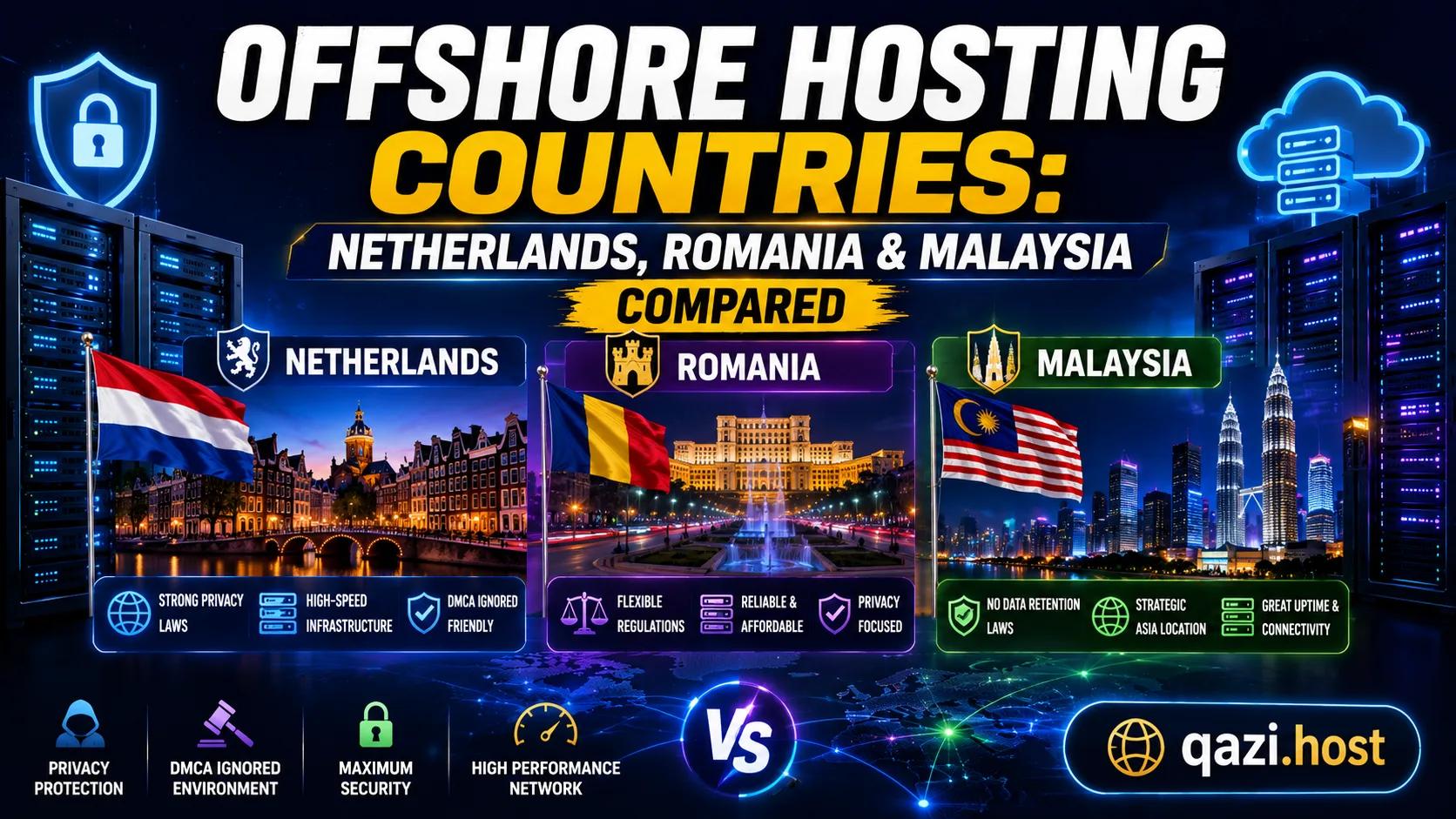
When people look for offshore hosting, they often search for "DMCA ignored hosting" or "privacy hosting" without thinking much about where the servers actually sit. But the hosting country matters enormously — it determines which laws apply, how courts handle copyright complaints, and what data protection your visitors benefit from.
This guide covers the three most common offshore hosting jurisdictions and helps you choose the right one for your project.
Why Jurisdiction Matters More Than You Think
Every server in the world sits in a building in a country. That country's laws govern what the hosting company must do when it receives a takedown request, a subpoena, or a court order. Choosing a jurisdiction is not about hiding — it is about choosing a legal framework that aligns with your content and protects you from abusive or politically motivated complaints.
The three factors to weigh:
- Copyright law — How strictly does the country enforce copyright complaints? Does it require court orders or just a notice?
- Data privacy law — What protections do visitors' data get? Is the country inside or outside GDPR jurisdiction?
- Infrastructure — Connectivity, latency, and uptime track records at the actual data centres used.
Netherlands (NL)
Legal Environment
The Netherlands operates under EU law (GDPR, Digital Services Act) plus Dutch national copyright law. Dutch courts have a strong track record of requiring proportionality in copyright enforcement. Hosting companies are not required to act on every informal DMCA-style complaint — they must be given notice of clearly unlawful content and given a reasonable time to respond.
The Netherlands is not bound by the US DMCA. Dutch law does not allow for auto-removal based on unverified allegations.
Data Privacy
Full GDPR compliance is mandatory. The Dutch Data Protection Authority (Autoriteit Persoonsgegevens) is one of the most active in Europe. For websites that handle user data, this is both a protection and a responsibility — your users get strong privacy rights, and you must operate accordingly.
Infrastructure
The Amsterdam Internet Exchange (AMS-IX) is one of the busiest internet exchange points in the world. Netherlands-hosted servers enjoy extremely low latency to Western Europe and reasonable latency to North America. Data centres like Equinix AM, InterXion, and AMS01 offer enterprise-grade facilities.
Best For
- News sites, journalism, and commentary protected by press freedom
- Businesses wanting EU privacy law coverage
- Any site needing maximum connectivity to Europe
- Resellers building hosting packages for European clients
Romania (RO)
Legal Environment
Romania is an EU member state and operates under EU law, but Romanian courts have historically been less aggressive about copyright enforcement than Western European counterparts. The country's legal system has significant delays in processing complex IP cases, which means valid court orders take longer to execute — giving legitimate content owners more time to respond and defend.
Like the Netherlands, Romania is not bound by US copyright statutes. DMCA notices have no direct legal force here.
Data Privacy
GDPR applies fully. Romania has its own data protection authority. In practice, data protection enforcement focuses on large-scale commercial violators, not small website operators.
Infrastructure
Romania has good tier-1 connectivity through carriers like Orange Romania and RCS&RDS. Latency to Western Europe averages 20–40ms, and to the US East Coast around 100ms. Data centre quality varies more than in the Netherlands — always ask which specific data centre your server sits in.
Best For
- Content that faces targeted, politically motivated takedown campaigns
- Sites needing a secondary or failover server to complement NL infrastructure
- Cost-sensitive projects — Romanian colocation and server costs are often lower than Amsterdam
Malaysia (MY)
Legal Environment
Malaysia is outside the EU entirely and operates under its own copyright and communications laws. The country has its own takedown procedures under the Communications and Multimedia Act 1998, but these apply primarily to Malaysian-targeted content. US DMCA notices have no legal standing here whatsoever.
Malaysia is often used for content targeting Southeast Asian and Middle Eastern audiences, where the EU's regulatory environment would add unnecessary compliance overhead.
Data Privacy
Malaysia's Personal Data Protection Act (PDPA) 2010 is the applicable law. It is less comprehensive than GDPR but still imposes obligations on data processors. Not suitable if your users are primarily EU-based and expect GDPR-level protections.
Infrastructure
Kuala Lumpur hosts several major data centres including CX1 and AIMS data centre. Latency to Southeast Asia and Australia is excellent — 10–30ms to Singapore, 50–80ms to Sydney. Latency to Europe is higher at 150–200ms.
Best For
- Sites primarily serving Asian audiences
- Projects that want complete separation from both EU and US legal frameworks
- E-commerce targeting Southeast Asian markets
Side-by-Side Comparison
| Factor | Netherlands | Romania | Malaysia |
|---|---|---|---|
| DMCA Binding? | No | No | No |
| GDPR Applicable? | Yes (mandatory) | Yes (mandatory) | No (PDPA only) |
| Copyright Enforcement Speed | Moderate (court required) | Slow (legal delays) | Slow (separate law) |
| EU Latency | Excellent (5–20ms) | Good (20–40ms) | Poor (150–200ms) |
| Asia-Pacific Latency | Poor (100–150ms) | Poor (120–160ms) | Excellent (10–50ms) |
| Typical Price Level | Higher | Lower | Moderate |
What About Iceland and Panama?
Iceland and Panama are sometimes mentioned as offshore hosting jurisdictions. Iceland benefits from strong press freedom laws and is popular with investigative journalists and whistleblower platforms. However, infrastructure options are limited and prices are high. Panama is more commonly used for domain registration and company formation than for actual hosting infrastructure.
For most practical hosting use cases — stability, uptime, connectivity, legal clarity — the Netherlands and Romania remain the most reliable choices.
Where Does Qazi.Host Operate?
At Qazi.Host, our primary infrastructure runs in the Netherlands with a secondary presence in Romania. This gives customers:
- Full GDPR data protection coverage
- No DMCA obligations — every complaint is reviewed on merit
- Excellent EU connectivity and solid global latency
- Redundancy across two EU jurisdictions
Whether you are launching a new site or moving an existing one away from a US host that has become unreliable under abusive takedowns, we are ready to help.
Our reseller hosting packages are especially popular with agencies and developers who manage multiple client sites — you get a single account with enough resources to run 10–50 client sites across two EU jurisdictions. Shared hosting works great for individual websites or blogs. Talk to us if you are unsure which fits your situation.
Written by
Ahtsham Khan Qazi
Founder & CEO, Qazi.Host · RHCSA · CCNA · 14+ years in server administration
Runs the shared, reseller and dedicated infrastructure behind Qazi.Host and writes these guides from the servers he administers. Corrections and questions are welcome on WhatsApp.
Read full bio →Related Articles
More guides on Offshore Hosting to help you make the right decision.
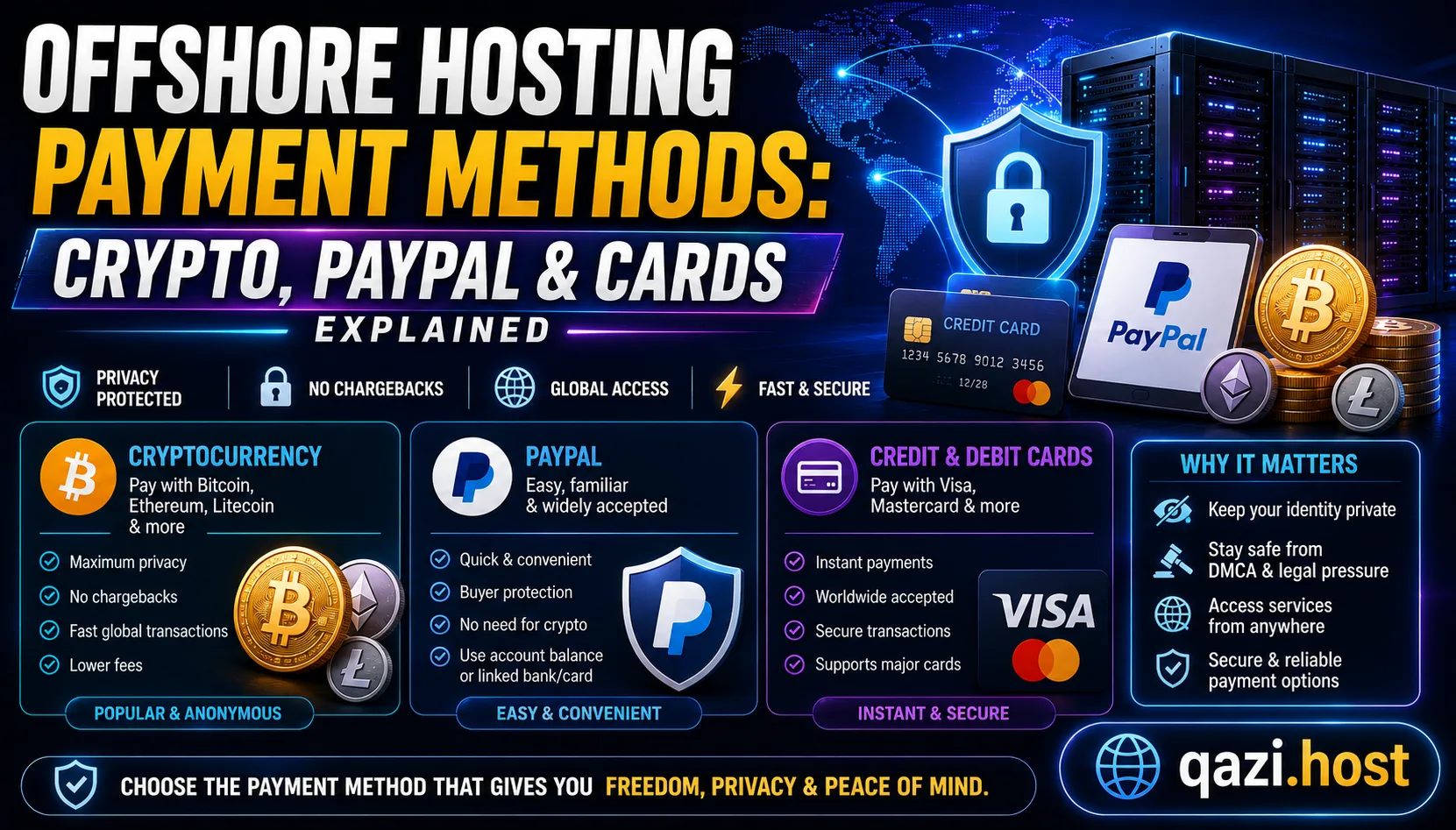
Offshore Hosting Payment Methods: Crypto, PayPal & Cards Explained
Which payment method should you use for offshore hosting? This guide covers the privacy, convenience, and reliability trade-offs between crypto, PayPal, and credit cards when paying for offshore hosting.
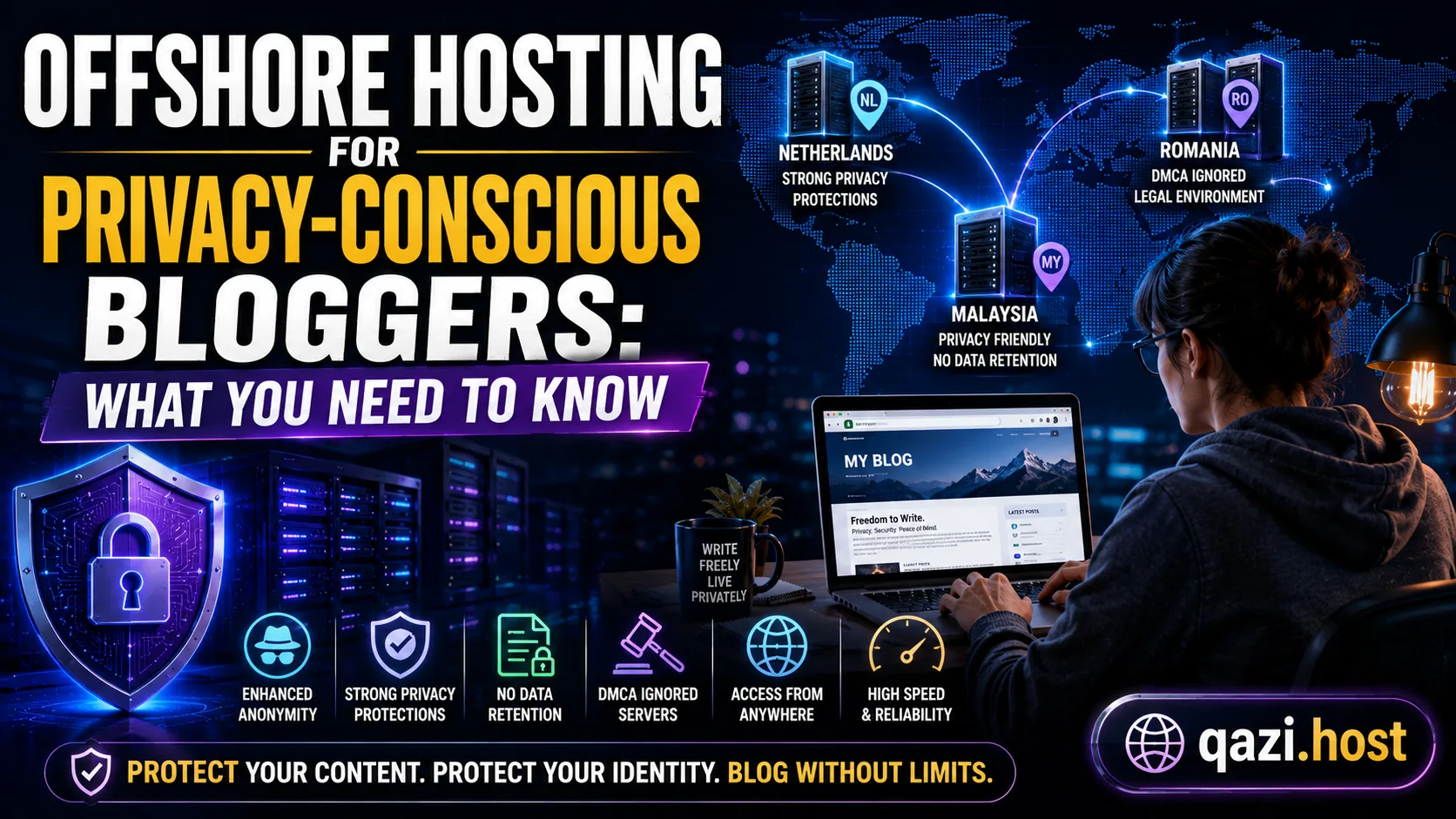
Offshore Hosting for Privacy-Conscious Bloggers: What You Need to Know
If you write about sensitive topics, political subjects, or anything that attracts powerful enemies, your hosting choice is part of your security posture. Here is what offshore hosting actually gives you.
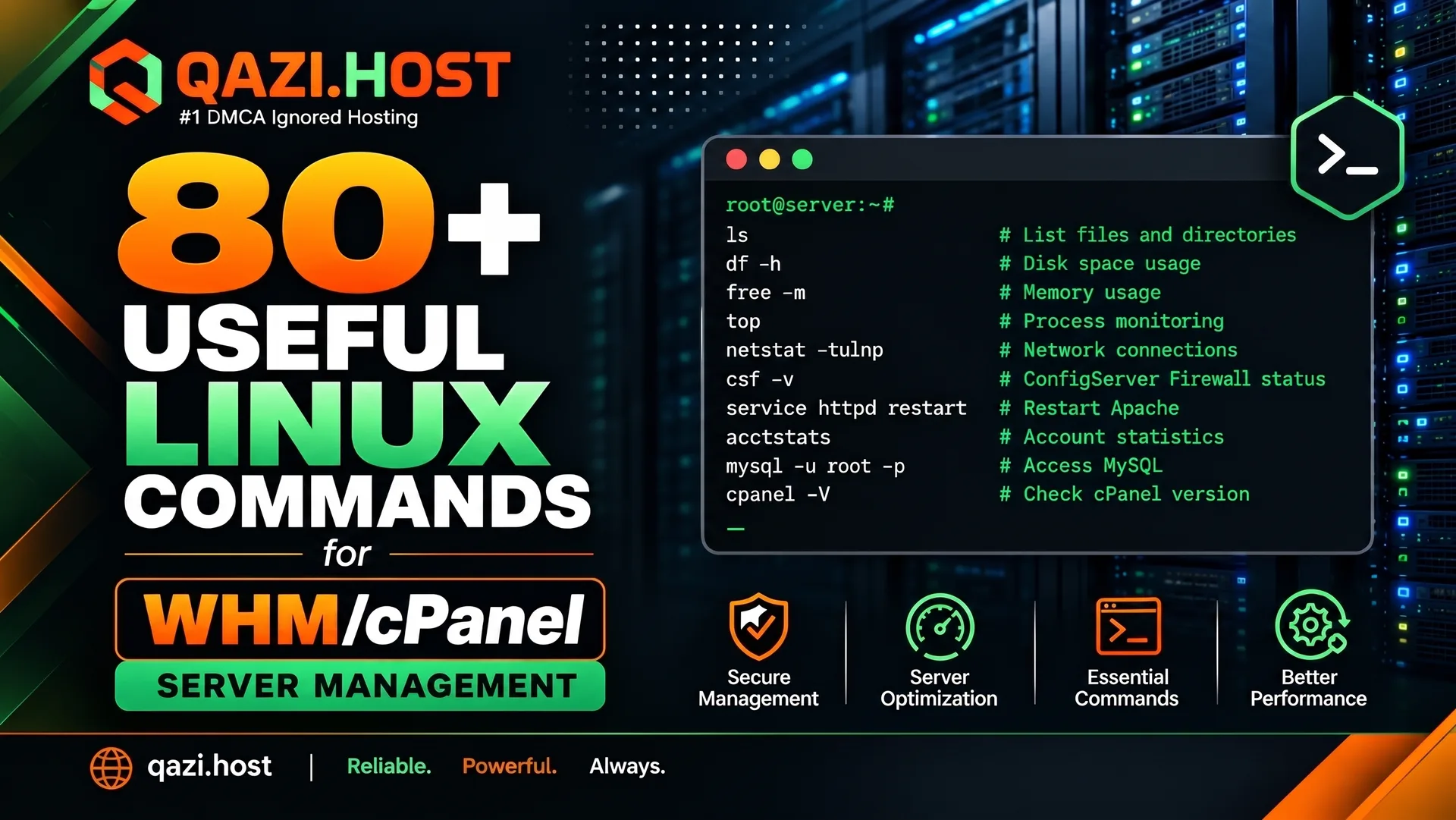
80+ Useful Linux Commands for WHM/cPanel Server Management
87 Linux commands for cPanel servers that admins actually use — SSH basics, cPanel scripts, Exim, MySQL, CSF, logs and disk cleanup, every command ready to copy.
cPanel Server Management and Monitoring: Complete Guide
What cPanel server management includes, what to monitor and alert on, the weekly routine, incident response, and installation vs management vs monitoring.